
New Preprint: Foundation Models for Epileptogenic Zone Identification
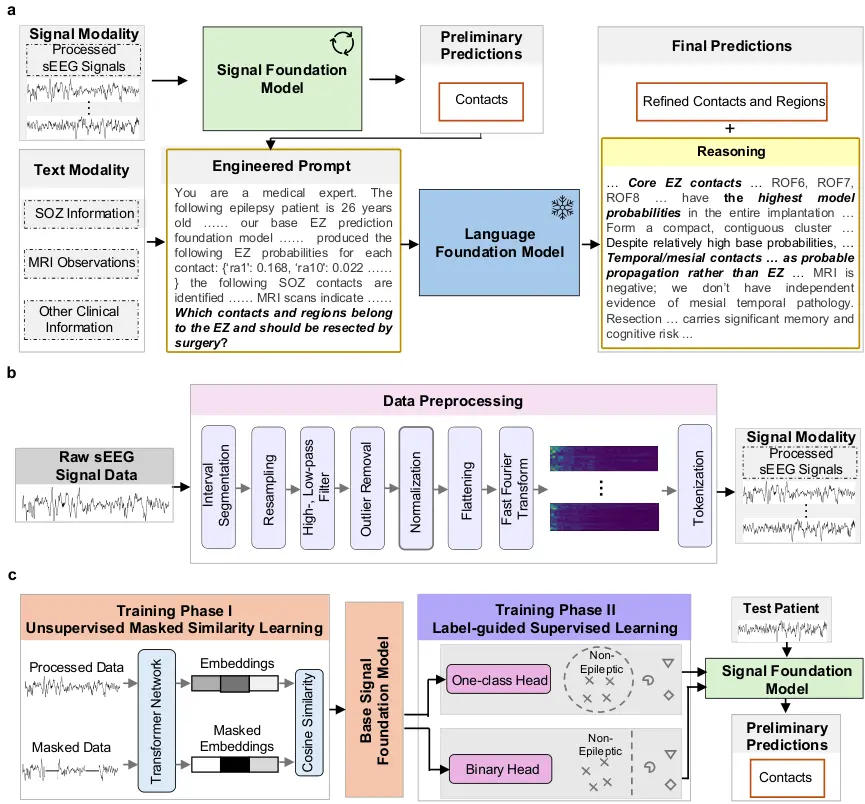
Our paper Foundation Models for Epileptogenic Zone Identification in Drug-Resistant Epilepsy is now available on arXiv (link). This is joint work with Thi Kieu Khanh Ho, Petr Klimes, Jan Cimbalnik, Martin Pail, Milan Brazdil, Birgit Frauscher, and Narges Armanfard.
Background
For patients with drug-resistant epilepsy, resective surgery — removing the brain region responsible for generating seizures — is often the best hope for seizure freedom. The critical challenge is accurately identifying the epileptogenic zone (EZ), the region that must be removed. Despite advances in clinical practice, seizure freedom rates after surgery remain below 50%.
EpiiSLM: A Dual Foundation Model System
We developed EpiiSLM, a system that combines two foundation models for EZ identification using stereo-electroencephalography (sEEG):
-
Signal Foundation Model — trained on over 104,000 minutes of sEEG recordings from the Montreal Neurological Institute & Hospital. A key design choice was to leverage all recordings regardless of surgical outcome and to anchor EZ biomarker extraction on non-epileptic signals, allowing us to use the full dataset without relying on imperfect surgical outcome labels.
-
Language Foundation Model — integrates the sEEG-derived outputs with multimodal clinical information (patient history, imaging findings, etc.) to produce interpretable, clinician-friendly predictions.
Results
Under leave-one-patient-out evaluation:
- 0.978 contact-level positive predictive value (PPV), outperforming the seizure onset zone (SOZ)-as-EZ baseline by 15.1% (p < 0.05)
- 100% region-level accuracy
- On an external dataset, EpiiSLM achieved 0.857 contact-level PPV
Importantly, EpiiSLM requires only one night of interictal sleep data, compared to the days or weeks of monitoring currently required. This suggests the potential to significantly reduce invasive sEEG monitoring duration and improve surgical outcomes for patients with drug-resistant epilepsy.