
Our Paper on Open-Set Time-Series Anomaly Detection Published at ECAI 2024
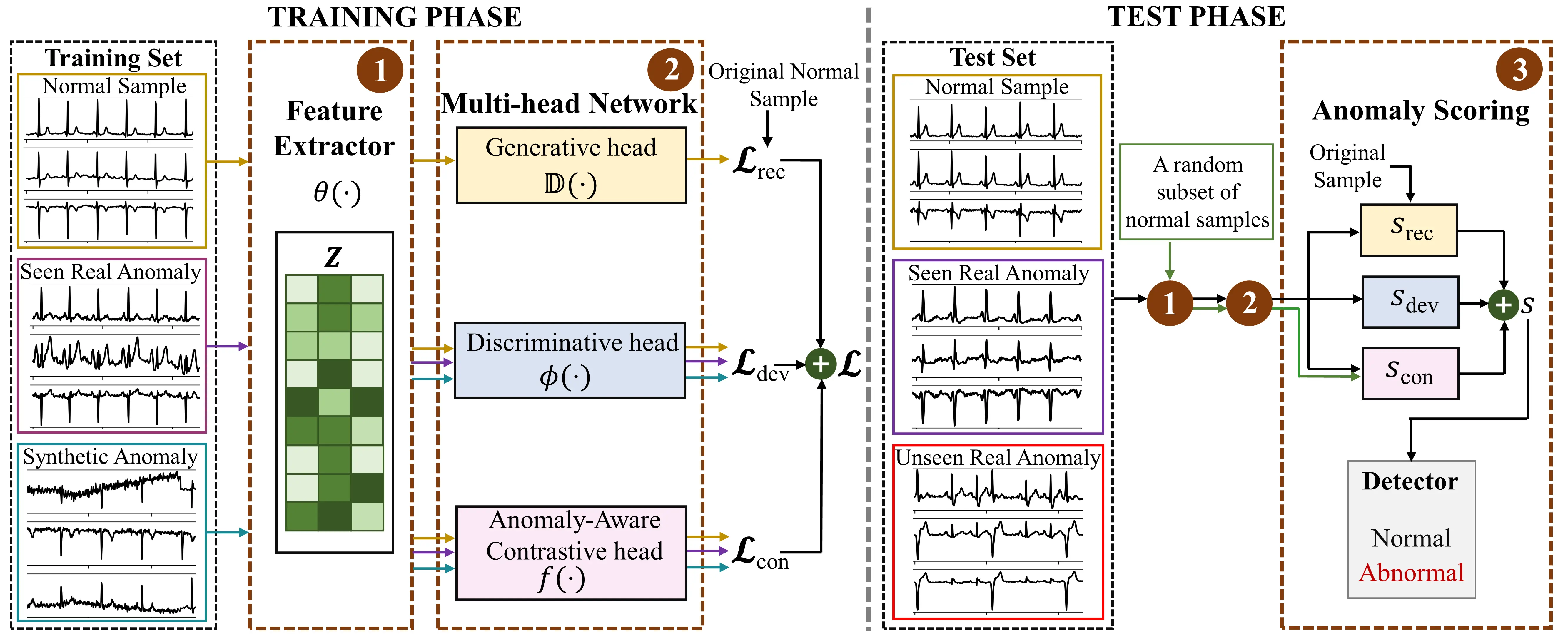
I’m excited to share that our paper Open-Set Multivariate Time-Series Anomaly Detection has been published at the 27th European Conference on Artificial Intelligence (ECAI 2024) in Santiago de Compostela, Spain, where it was presented as an oral.
The Problem
Time-series anomaly detection (TSAD) is critical across many domains — from industrial monitoring to healthcare. Most existing TSAD methods fall into two camps: unsupervised methods that train only on normal data, and supervised methods that require labeled anomalies. The issue? Unsupervised approaches lack discriminative power, while supervised methods tend to overfit to seen anomaly types and fail to generalize to novel, unseen anomalies.
In real-world settings, we often have access to a few labeled anomalies from a limited number of classes, but need to detect completely new types of anomalies at test time. This is the open-set anomaly detection problem.
Our Approach: MOSAD
We propose MOSAD (Multivariate Open-Set Time-Series Anomaly Detector), a multi-head framework that combines three specialized heads on top of a shared representation space:
- Generative Head — reconstructs normal patterns to detect deviations
- Discriminative Head — leverages the few available labeled anomalies
- Anomaly-Aware Contrastive Head — creates a representation space that is more effective for anomaly detection than standard supervised contrastive learning
By combining these complementary perspectives, MOSAD achieves state-of-the-art performance on three real-world datasets, demonstrating superior adaptability and robustness to unseen anomaly types compared to both conventional supervised and unsupervised methods.